
I discovered Nico Patino while scrolling on Instagram reels on a random afternoon in November. The video featured him listening to a woman’s story about navigating divorce later in life. He wrote her a beautiful poem on the spot on a typewriter. I gave him a follow and I was intrigued to hear more from him. Luckily for me, he had been working on his first book-bound collection of poetry and he was releasing it independently. I thought purchasing and reviewing his book would be a wonderful start to my blog. As someone who has also attempted to navigate being an independent artist, I truly understand that every contribution from consumers, big or small, can snowball into a new chapter for the artist. Supporting up-and-coming artists allows the field to be increasingly accessible and I will uphold my part in that movement in any and every way I can. With that being said, here’s the review:
Cupid of the Mess is a collection that boasts sincerity. Patino’s poetic voice is vulnerable and unafraid to shy away from the skeletons people normally hide. His diction exudes his unique and individualized personality atop an array of universally shared experiences. Patino has arranged these poems to be a loosely chronological self portrait of his life. They uncover the intricacies of love, loss, life, nature, divinity, philosophy, and much more. His imagery regarding nature is breathtakingly beautiful. Through this timeline of poems, he not only shines a light on his culture and origin, but equally reflects on his dedication to his journey in search of purpose and something he can truly call home. Although it is impossible to summarize the journey of this piece as a whole—as it is very unique to Patino’s personal experience—his philosophies and experiences ring universally true. The leading quote in reference to the work’s title Cupid of the Mess says, “What wealth I have made to afford all this mess.” I resonate with this quote a lot as it aligns with one of my personal favorite philosophies from Friedrich Nietzsche concerning loving one’s fate aka Amor Fati. Keeping this mantra in mind while reading his poems gives the reader an important lens to Patino’s look on his life in hindsight. This collection contains over 110 poems, my personal favorites reflect on divinity, love, and grief.
Because I have so many favorites from this collection, I was struggling to pick just one to dive deeper into to analyze. However, the beauty of the imagery and philosophy in “kairas” particularly stuck out for me as one that would be the most fun to close read! Here’s a picture to read the poem along with my annotations:
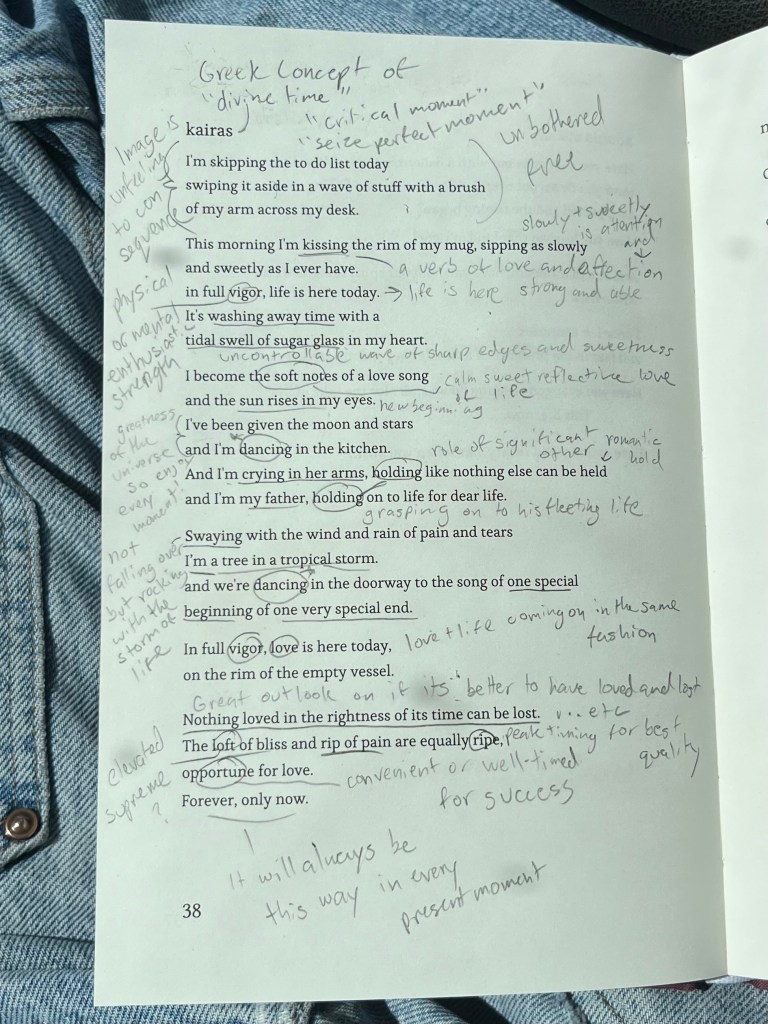
I noted primarily that the first stanza sets a dangerously liberating mood for the poem as he describes the image of his arm brushing across his desk, “skipping [his] to do list today/swiping it aside in a wave of stuff” (1-2). This moment contrasts the feeling of unbothered freedom with a looming worry that responsibilities might catch up to that liberation.
He follows this moment with the act of, “kissing the rim of [his] mug, sipping as slowly/and sweetly as [he] ever ha[s]” (4-5). The verb choice in Patino’s diction reconstructs the moment to be one of love and affection rather than mundane. This connects to the way he describes life’s presence as being “in full vigor” (6). This further defends the notion that this poem is releasing the reader from perceiving life passively. He fills seemingly mundane moments with passion and the essence of life with enthusiastic strength and presence through his poetic images and enchanting diction.
Patino recognizes the bittersweetness of life’s temporal nature through the lines, “It’s washing away time with a/tidal swell of sugar glass in my heart” (7-8). The “tidal swell” is an uncontrollable image of a wave dominating suddenly and all at once. The “sugar glass” contrasts sweetness with sharp edges which seemingly aligns with the experience of life. Finally, for this gigantic event that seems boundless to all occur “in [his] heart” truly allows the reader to recognize the greatness and power of love and humanity that can be omitted from a singular person.
In the third stanza, Patino creates beautiful metaphors and images that show deep appreciation for life and all its moments, good and bad. In “becom[ing] the soft notes of a love song,” (9) Patino takes a calm, sweet, and gentle approach to praising his passion for the nature of life. He recognizes graciously, “I’ve been giving the moon and the stars” (10). He frames the existence of the universe as a gift. Through this realization, he treats his own life as a privilege and celebration. This leads him to, “dancing in the kitchen… crying in her arms… and… holding on to life for dear life” (11-13). In moments of joy, love, sadness, grief, and all that could be in between, Patino preaches that they should all be passionately appreciated and recognized as unique parts that make up the whole divine gift of life itself.
Patino includes more metaphorical images depicting human nature and its place in the midst of the swells of life. He writes that even amongst the “rain of pain and tears,” he is but “a tree [swaying] in a tropical storm” (14-15). He chooses not to say that the tree is in danger–being toppled over or flung out from its root–but rather that swaying through the storm is the appropriate and natural response to seize the moments of hardship most optimally.
His concluding lines pack philosophical notions of enlightenment that offer the reader a liberating breath of fresh air and peace of mind. “Nothing loved in the rightness of its time can be lost” (20). This appears to be the perfect answer to the pressing emotional dilemma: “Is it better to have loved and lost than to have never loved at all?” Again, this quote reiterates that life occurs with divine timing above human understanding. It’s all too easy and common for humans to dwell on pain and to disregard moments of peace or joy as trivial or mundane. This quote serves again as a reminder that being alive and the privilege of getting to love is something precious. He writes and concludes that both “the loft of bliss and rip of pain are equally ripe, [and] opportune for love./ Forever, only now” (21-23). Timing is the surrounding focus of his diction in these lines which greatly connects and wraps around to the title of the piece being “kairas.” Kairas is a Western Indian relish/curry side dish that is known for its multi-flavor profile (sweet, sour, spicy, and bitter). While these flavors align with the polarities of life that this poem references, this title could also be in reference to the Greek word kairos, which means “the critical time.” Kairos implies that there is a perfect or divine moment, which connects to the statements made in lines 20-23. These all reference the accuracy and precision of life and love’s timing. This notion is comforting to go on with as it alleviates doubts of conditions out of an individual’s control.
Overall, I feel like this poem greatly represents one of my favorite aspects of Patino’s collection being his perspectives and philosophies regarding life as a gift. His poetic structure, diction, and images greatly reframe these experiences and ideas to allow the reader a fresh understanding of why approaching life with passion and gratitude is ultimately fulfilling above “the to do list [of] today” (1).
I hope whoever reads this decides to support Patino’s journey! His Instagram is @nicpatino and his website is http://www.nicopatino.com where you can order a copy of his book Cupid of the Mess which includes “kairas” and many other remarkable poems.


