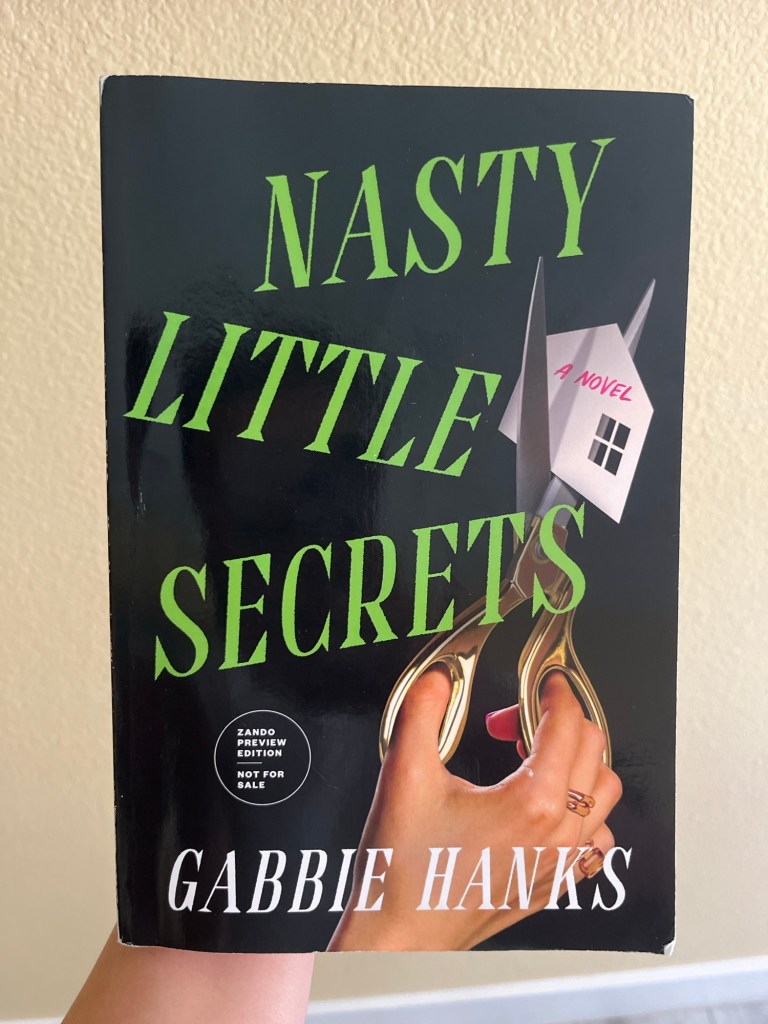
Nasty Little Secrets by Gabbie Hanks: Uncorrected Proof Official Release: June 16, 2026
As an employee at Barnes & Noble, I am extremely lucky to have access to advanced reader copies of select books. Having these copies available to booksellers allows employees to stay informed on titles before their release. One of the titles I picked up recently for myself was Gabbie Hanks’s debut novel Nasty Little Secrets.
Nasty Little Secrets is a psychological suspense where protagonist Rose Dearling scrambles to uncover the mystery behind her recently missing younger sister. Rose Dearling is bestselling author whose most notable title is a fictional retelling of her brother’s alleged false murder trial. Rose has faced constant backlash for her book as the general public disagrees with its sentiment that her brother was falsely imprisoned. However, she realizes her book might hold the answers to uncover her sister’s sudden disappearance as the two cases might be more related than they seem.
I personally do not typically gravitate towards the genre of suspense/mystery. However, I was compelled by the books synopsis and the author’s background. Gabbie Hanks is a former librarian and now works in literacy for the government. She is an avid psychological suspense reader and this is her debut novel. Hank’s experience with literature absolutely catapulted the quality of her debut out of the park. Even as someone who does not frequently indulge in this genre, I was so captivated by her story, right from the first chapter. Her novel has a touch of familiar modernity and immediately fills the stories with clues and moments that leave you questioning and page-turning consistently. This has been one of my most enjoyable reads this year and I would definitely recommend it to any other new psychological suspense/mystery readers who want an undeniably exciting taste of the genre.
The “book inside of the book” narrative framing device functions as a celebration of the impact of fiction. While reading this story, I often connected the novel’s events to Ralph Waldo Emerson’s quote, “Fiction reveals truth that reality obscures.” The fictional book in the novel and Hanks’s actual novel both reveal hidden truths. Rose Dearling’s novel does so by containing clues regarding her brother’s mistrial and her sister’s disappearance. Gabbie Hanks’s novel does so by functioning as a societal commentary on how women are treated in the public eye, sexual assault in varying lights, and the cruelties and injustice that can occur within the criminal justice system.
I am so grateful to have had the opportunity to read Hanks’s advanced reader copy of her debut novel and I’m excited to see her journey begin and take off!
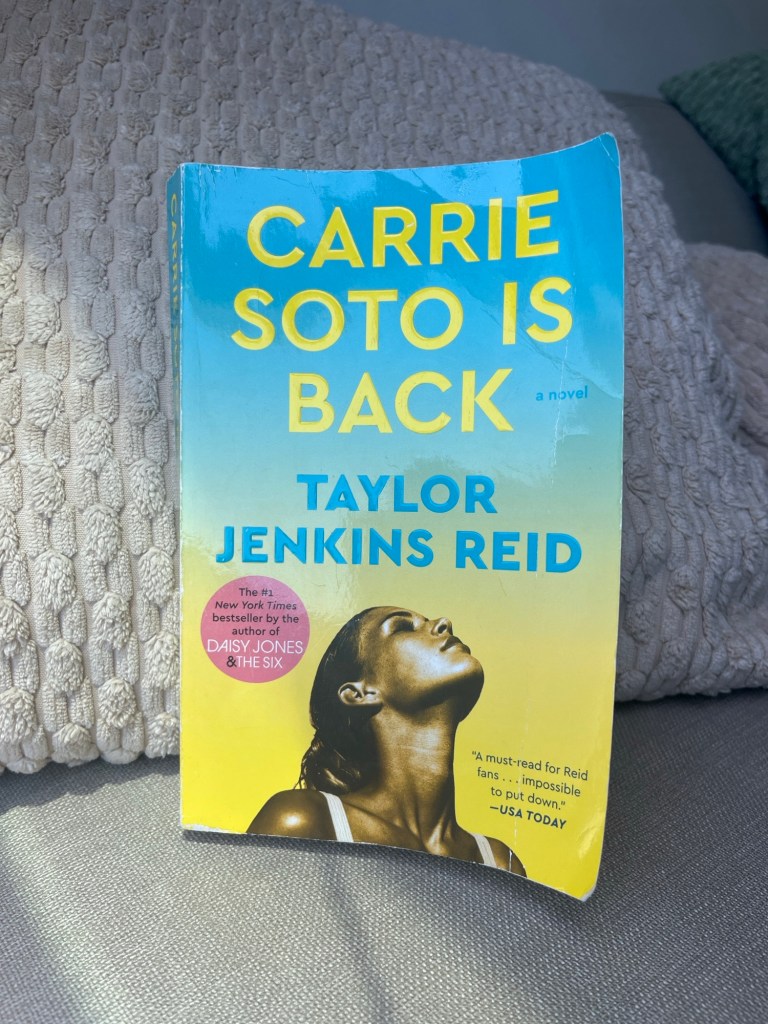
Carrie Soto is Back: A Novel by Taylor Jenkins Reid
It feels almost like second-nature for me to praise Taylor Jenkins Reid’s stories. She is notably my favorite author and has captured the spots for my absolute favorite books with her novels Daisy Jones and The Six and The Seven Husbands of Evelyn Hugo. As I work my way through her bibliography, I continue to be amazed by the nature of her storytelling. The dedication she puts into the research necessary to create the immersive experience of her novels is astounding. The pacing of her plots are addictive and her characters elicit everlasting empathy and support from any reader through Reid’s adoring prose. Reid understands a plethora of different worlds which makes her stories so valuable to consume. With each novel of hers I consume, I gain empathy beyond what I could ever understand or experience for myself through her characters tangible emotions and histories placed in Reid’s well-researched sectors of society. These statements are deeply present in her novel Carrie Soto is Back. Carrie Soto’s character wrestles with the effects of striving for superhuman greatness. Her arc also serves as an insightful reflection of the way women are treated in sports media, especially focusing on the contrast between the expectations of men versus the unreasonably limiting standards for women. This story is a stellar read for any athlete/sports fan and/or fan’s of Reid’s woman-centered fiction.
Random House Book Club shares novels to those subscribed to their newsletter along with A Book Club Guide of questions to encourage the discussion and engagement of important stories. I thought I would share my thoughts on some of the points of discussion to compliment my reflection/review of Reid’s novel.
Carrie sees tennis as a world of winners and losers. What do you think of that view? How can such an outlook be beneficial, and how could it be detrimental?
My personal take on this view is that it is ultimately damaging for an individual’s character. I do not think it’s ultimately healthy for one to define themselves by results. Self-worth should be intrinsically recognized, not defined by external factors. This outlook could be beneficial when facing the cutthroat pressure of sports media on women as well as a challenging parental expectation as it creates an overwhelming push to work harder knowing that your self-image and definition is on the line. However, like I primarily stated, this outlook is ultimately detrimental because although it manifests a strong motivation, it is rooted in a toxic mentality which will ultimately not bring fulfillment. I will refrain from referencing moments in the novel to support my ideas as to not include spoilers in this post!
The tabloids were vicious, leading Carrie to posit, “I should never let on how much I wanted to win or, worse, that I believed I deserved to win.” What’s your take on how the media in the novel presented Carrie’s story?
My take on how the media in the novel presented Carrie’s story is that a great majority of her coverage was projected through a lens of unequal and unjust expectations for women in her field. A man in Carrie’s position would not have been criticized the same way she was. A man is allowed to speak out and be a vicious victor. However, it was made clear throughout the novel that women were expected to be something else for the sport. Carrie was often criticized for her appearance while the same media praised her opponents because they were skinnier, blonder, sweeter, and quieter. The sports coverage in the novel expected women to be gracious and kind. In order to fulfill this image, women like Carrie could not be angry without being judged and could not act like a “warrior” expecting victory in the essence of destiny. That sort of independent security and power was reserved for the men of the sport. To find out more about what the media had to say about Carrie Soto and how she landed her nickname “The Battle-Axe,” give Taylor Jenkins Reid’s Carrie Sotois Back a read!
I discovered Nico Patino while scrolling on Instagram reels on a random afternoon in November. The video featured him listening to a woman’s story about navigating divorce later in life. He wrote her a beautiful poem on the spot on a typewriter. I gave him a follow and I was intrigued to hear more from him. Luckily for me, he had been working on his first book-bound collection of poetry and he was releasing it independently. I thought purchasing and reviewing his book would be a wonderful start to my blog. As someone who has also attempted to navigate being an independent artist, I truly understand that every contribution from consumers, big or small, can snowball into a new chapter for the artist. Supporting up-and-coming artists allows the field to be increasingly accessible and I will uphold my part in that movement in any and every way I can. With that being said, here’s the review:
Cupid of the Mess is a collection that boasts sincerity. Patino’s poetic voice is vulnerable and unafraid to shy away from the skeletons people normally hide. His diction exudes his unique and individualized personality atop an array of universally shared experiences. Patino has arranged these poems to be a loosely chronological self portrait of his life. They uncover the intricacies of love, loss, life, nature, divinity, philosophy, and much more. His imagery regarding nature is breathtakingly beautiful. Through this timeline of poems, he not only shines a light on his culture and origin, but equally reflects on his dedication to his journey in search of purpose and something he can truly call home. Although it is impossible to summarize the journey of this piece as a whole—as it is very unique to Patino’s personal experience—his philosophies and experiences ring universally true. The leading quote in reference to the work’s title Cupid of the Mess says, “What wealth I have made to afford all this mess.” I resonate with this quote a lot as it aligns with one of my personal favorite philosophies from Friedrich Nietzsche concerning loving one’s fate aka Amor Fati. Keeping this mantra in mind while reading his poems gives the reader an important lens to Patino’s look on his life in hindsight. This collection contains over 110 poems, my personal favorites reflect on divinity, love, and grief.
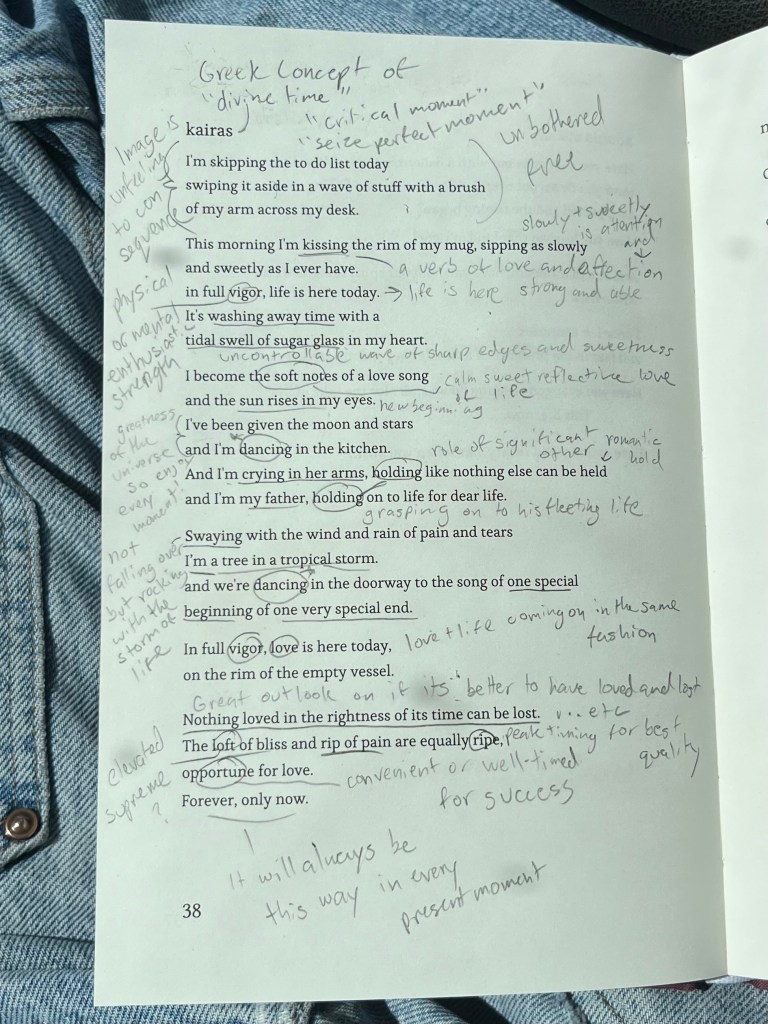
Because I have so many favorites from this collection, I was struggling to pick just one to dive deeper into to analyze. However, the beauty of the imagery and philosophy in “kairas” particularly stuck out for me as one that would be the most fun to close read! Here’s a picture to read the poem along with my annotations:
I noted primarily that the first stanza sets a dangerously liberating mood for the poem as he describes the image of his arm brushing across his desk, “skipping [his] to do list today/swiping it aside in a wave of stuff” (1-2). This moment contrasts the feeling of unbothered freedom with a looming worry that responsibilities might catch up to that liberation.
He follows this moment with the act of, “kissing the rim of [his] mug, sipping as slowly/and sweetly as [he] ever ha[s]” (4-5). The verb choice in Patino’s diction reconstructs the moment to be one of love and affection rather than mundane. This connects to the way he describes life’s presence as being “in full vigor” (6). This further defends the notion that this poem is releasing the reader from perceiving life passively. He fills seemingly mundane moments with passion and the essence of life with enthusiastic strength and presence through his poetic images and enchanting diction.
Patino recognizes the bittersweetness of life’s temporal nature through the lines, “It’s washing away time with a/tidal swell of sugar glass in my heart” (7-8). The “tidal swell” is an uncontrollable image of a wave dominating suddenly and all at once. The “sugar glass” contrasts sweetness with sharp edges which seemingly aligns with the experience of life. Finally, for this gigantic event that seems boundless to all occur “in [his] heart” truly allows the reader to recognize the greatness and power of love and humanity that can be omitted from a singular person.
In the third stanza, Patino creates beautiful metaphors and images that show deep appreciation for life and all its moments, good and bad. In “becom[ing] the soft notes of a love song,” (9) Patino takes a calm, sweet, and gentle approach to praising his passion for the nature of life. He recognizes graciously, “I’ve been giving the moon and the stars” (10). He frames the existence of the universe as a gift. Through this realization, he treats his own life as a privilege and celebration. This leads him to, “dancing in the kitchen… crying in her arms… and… holding on to life for dear life” (11-13). In moments of joy, love, sadness, grief, and all that could be in between, Patino preaches that they should all be passionately appreciated and recognized as unique parts that make up the whole divine gift of life itself.
Patino includes more metaphorical images depicting human nature and its place in the midst of the swells of life. He writes that even amongst the “rain of pain and tears,” he is but “a tree [swaying] in a tropical storm” (14-15). He chooses not to say that the tree is in danger–being toppled over or flung out from its root–but rather that swaying through the storm is the appropriate and natural response to seize the moments of hardship most optimally.
His concluding lines pack philosophical notions of enlightenment that offer the reader a liberating breath of fresh air and peace of mind. “Nothing loved in the rightness of its time can be lost” (20). This appears to be the perfect answer to the pressing emotional dilemma: “Is it better to have loved and lost than to have never loved at all?” Again, this quote reiterates that life occurs with divine timing above human understanding. It’s all too easy and common for humans to dwell on pain and to disregard moments of peace or joy as trivial or mundane. This quote serves again as a reminder that being alive and the privilege of getting to love is something precious. He writes and concludes that both “the loft of bliss and rip of pain are equally ripe, [and] opportune for love./ Forever, only now” (21-23). Timing is the surrounding focus of his diction in these lines which greatly connects and wraps around to the title of the piece being “kairas.” Kairas is a Western Indian relish/curry side dish that is known for its multi-flavor profile (sweet, sour, spicy, and bitter). While these flavors align with the polarities of life that this poem references, this title could also be in reference to the Greek word kairos, which means “the critical time.” Kairos implies that there is a perfect or divine moment, which connects to the statements made in lines 20-23. These all reference the accuracy and precision of life and love’s timing. This notion is comforting to go on with as it alleviates doubts of conditions out of an individual’s control.
Overall, I feel like this poem greatly represents one of my favorite aspects of Patino’s collection being his perspectives and philosophies regarding life as a gift. His poetic structure, diction, and images greatly reframe these experiences and ideas to allow the reader a fresh understanding of why approaching life with passion and gratitude is ultimately fulfilling above “the to do list [of] today” (1).
I hope whoever reads this decides to support Patino’s journey! His Instagram is @nicpatino and his website is http://www.nicopatino.com where you can order a copy of his book Cupid of the Mess which includes “kairas” and many other remarkable poems.
My name is Franchesca McVerry. I’m about to receive my Associates Degree for Transfer in English at Orange Coast College in May. I’m planning to transfer to the University of California Irvine in the Fall of 2026 to complete my Bachelor’s degree. My long term career goals after university include involvement in the New York book publishing industry. I would love to work as an editor and be able to read and guide the best new titles to their respective optimal versions. However, any opportunity that would utilize my engagement and passion towards novels and other literature is greatly alluring to me.
I created this book blog to act as a portfolio of my independent engagement with literature outside of my university assignments. Alongside this blog, I work part-time at Barnes & Noble. I’m currently a barista, but I look forward to engaging with the store’s Monthly Picks and the Advanced Reader Copies available to the employees before taking on or completely transitioning to a role as a bookseller. I will include my complete resume somewhere on this website, feel free to contact me with any opportunities regarding literary engagement!
I’m mainly making this post—not just an introduction to myself—but also as a preface that this is my first book blog ever! I plan to mainly construct reviews on novels and other works I enjoy and will occasionally apply analysis I’ve developed through my coursework. However, please feel free to reach out to me with suggestions, guidance, or advice on my approach towards posts. I’m always open to adapting and learning something new.
With that being said, I hope to post as frequently as possible. However, in balancing this blog along with college/university, my part-time job, and private reviews on ARCs, my posting intervals may be inconsistent. My goal is to aim for at least one post a month.
Thanks for taking the time to read through this! I hope I can provide some valuable insight through this project and maybe offer engaging recommendations 🙂 My first post is going to be covering Nico Patino’s debut collection of poetry titled Cupid of the Mess. Stay tuned!